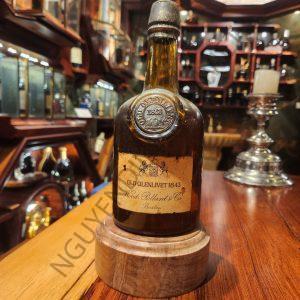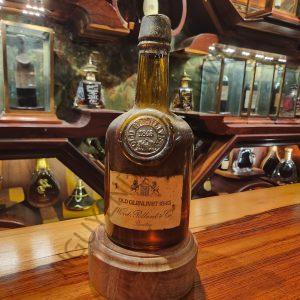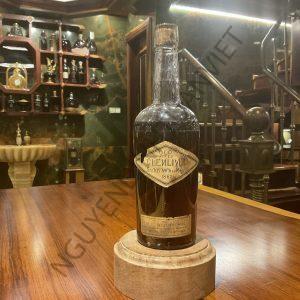


In the world of fine whisky, some bottles are valued for their rarity, others for their age. Yet there are a select few that transcend material worth altogether and become part of human history itself. Whisky 1833 is one such artifact — a treasure emerging from the past, carrying with it nearly two centuries of mystery, debate, and desire among collectors around the world.
In late 2022, within the ancient cellars of Blair Castle, castle manager Bertie Troughton uncovered a hidden cache of long-forgotten whisky bottles. After discussions with older generations of the Atholl family, it was confirmed that the existence of these bottles had once been known, though over time they had been concealed and gradually faded into obscurity — as if waiting for the right moment to re-emerge into the light of history.
The discovery consisted of approximately 40 bottles of antique whisky — an extraordinarily rare quantity for any whisky artifact dating back to the early nineteenth century. Some bottles are to remain permanently preserved and displayed at Blair Castle as part of the Atholl family heritage and the castle’s long-standing connection to the Scotch whisky industry. Only 24 bottles were selected for release to the world through an exclusive auction conducted by Whisky Auctioneer in November 2023, making each bottle an almost singular artifact within the global whisky collecting community.
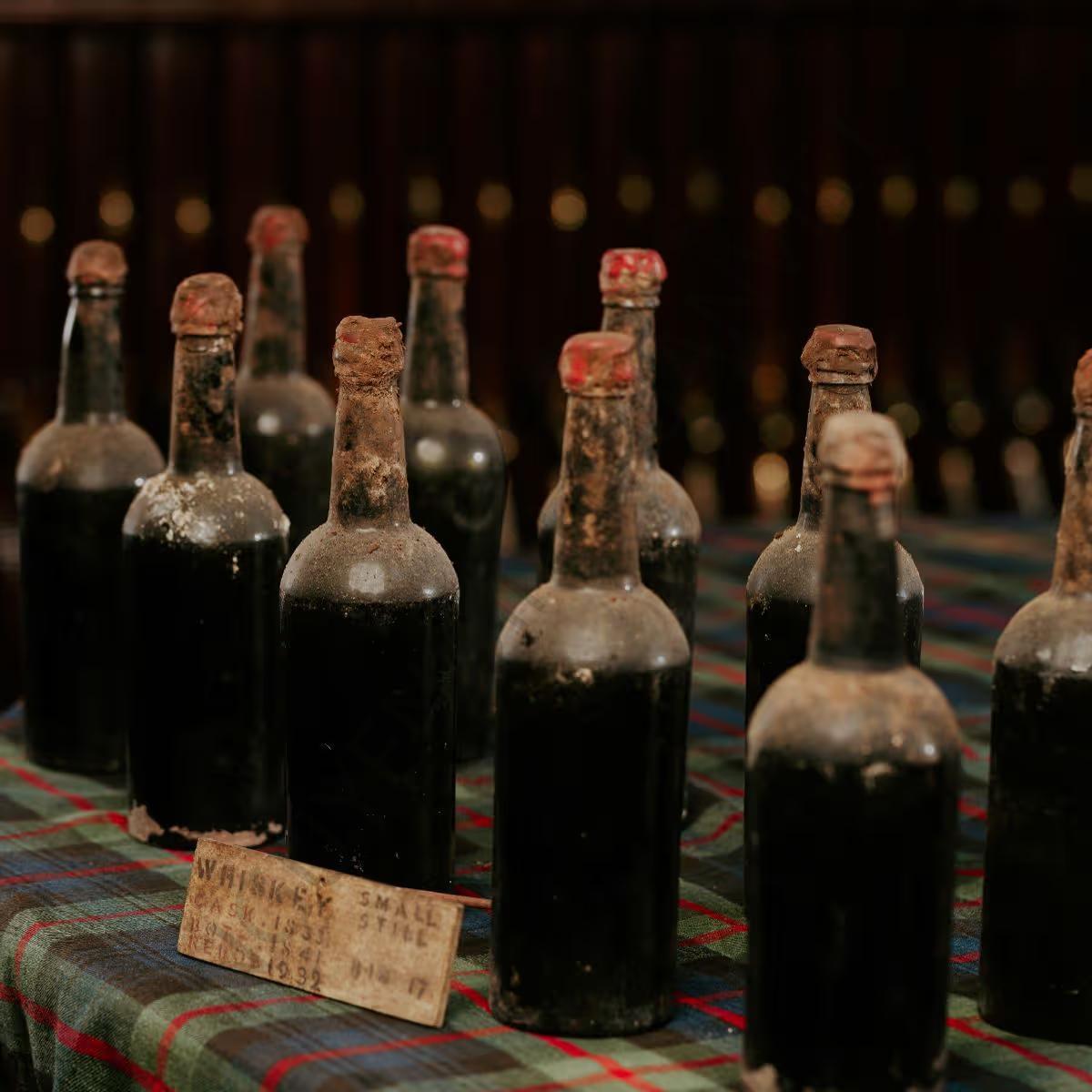
Alongside the bottles, a wooden plaque was discovered bearing the inscription:
“Whisky, small still, distilled in 1833, bottled in 1841 and rebottled in 1932.”
Those words alone were enough to send shockwaves through the whisky world. If the timeline recorded on the plaque is accurate, this could very well represent the oldest vintage Scotch whisky known to exist today.
What makes Whisky 1833 extraordinary is not merely its near two-century age, but the mysterious journey surrounding its rediscovery. The bottles were found within the cellar of Blair Castle — the historic seat of the Murray family and the Dukes of Atholl, a residence that famously welcomed Queen Victoria during her Highland visit in 1844. The castle is also closely tied to the Atholl Highlanders, the only remaining private army in Europe and one of Scotland’s most remarkable historical symbols.
Archival records preserved at the castle provide compelling evidence supporting the whisky’s age. A warehouse ledger from 1834 documents the presence of “40 gallons whisky in wood,” while records from 1841 confirm that spirit bottling activities were taking place at the castle during precisely the same period referenced on the wooden plaque. Additional documents also reveal that whisky production was carried out on the Atholl estate during the early nineteenth century, including correspondence between estate managers and tenants concerning distillation, as well as surviving distillation equipment from that era.
Beyond the historical evidence, extensive modern scientific analysis has also been conducted to authenticate the whisky. The Scottish Universities Environmental Research Centre (SUERC) performed radiocarbon testing, with results consistent with several nineteenth-century vintages, including 1833. Meanwhile, the Scotch Whisky Research Institute (SWRI) confirmed that the sample possessed an alcohol strength of 61.36% ABV — an astonishing figure for a whisky approaching 200 years of age.
Additional chemical analysis indicated that the spirit had undergone maturation in oak casks and remained stored in glass bottles for an exceptionally long period. The profile of volatile compounds strongly suggests that this was a malt whisky produced using traditional nineteenth-century Scottish distillation methods. Further studies conducted by The University of Edinburgh concluded that the composition aligned more closely with malt whisky than grain whisky, while preliminary metal analysis revealed traces of copper characteristic of distillation in small copper pot stills.
Yet paradoxically, it is precisely this lingering uncertainty that enhances the legendary aura of Whisky 1833.
Experts continue to debate whether the liquid inside the bottle remains entirely original from 1833, or whether it may have been re-corked or partially replenished during the “rebottling” process in 1932. But within the world of elite collecting, the most fascinating artifacts are not always those with perfect answers — they are often the objects that still carry mysteries beyond complete explanation.
Whisky 1833 exists almost like a “Schrödinger’s Whisky” — suspended between history and legend, between verified fact and unresolved theory. It is not simply a bottle of whisky, but a nearly two-century-long dialogue between time, memory, and human belief.
Whether or not it is ultimately confirmed as the oldest whisky bottle in the world, one fact remains undeniable: it is among the oldest Scotch whiskies ever discovered and preserved in such astonishing condition. The discovery of so many bottles together created an opportunity that may never occur again — the opportunity to own, preserve, and perhaps even taste a fragment of early nineteenth-century Scotch whisky history.
Even more remarkably, among the approximately 40 bottles of Whisky 1833 discovered at Blair Castle, one exceptionally rare example has now officially arrived in Vietnam. Its presence represents far more than a collector’s acquisition; it marks Vietnam’s entry into the preservation journey of some of the rarest whisky heritage ever known to exist.
For true collectors, Whisky 1833 is not merely an antique whisky bottle. It is a legacy. A witness to Scottish history. An artifact carrying the spirit of the Victorian era. And above all, it is a symbol of humanity’s enduring pursuit of values that transcend time itself.